

Dew
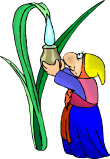 When air is cooled the amount of water vapour that it can hold decreases. At the dew point temperature, air is saturated. A further fall in temperature will result in condensation of excess water vapour in the form of water droplets. On the ground this is known as dew.
When air close to the ground cools at night through a loss of radiation the temperature often falls below the dew point temperature and dew may form. Dew forms most easily over grass because the thin layer of air next to it is always moist due to water transpiration by the grass blades. Wind sometimes limits or prevents the formation of dew because the cooling surface air is readily mixed with air above it. The wind also increases the rate of evaporation, precluding the formation of water droplets.
When dew freezes it is known as frost. If the dew point temperature is below freezing, any condensation of water vapour takes place directly as ice crystals known as hoarfrost.
| Dew |
 Print Topic
Websites
Other topics
• Dew & Frost
• Australian Severe Weather
• Dew & Frost
• Introduction to Weather
• Anticyclones
• Beaufort Scale
• Cirrus Clouds
• Clouds
• Cold Fronts
• Condensation
• Convection
• Cooling Air
• Cumulonimbus Clouds
• Cumulus Clouds
• Depressions
• Dew
• Dew Point
• Energy
• Evaporation
• Fog
• Forecasting
• Fronts
• Frost
• Humidity
• Hurricanes
• Isobars
• Measuring Weather
• Meteorology
• Monsoons
• Movement of Air
• Occluded Fronts
• Precipitation
• Pressure
• Sea Breeze
• Stability of Air
• Stratus Clouds
• Sunshine
• Synoptic Charts
• Temperature
• Thunderstorms
• Tornadoes
• Uplift of Air
• Warm Fronts
• Water Cycle
• Weather Symbols
• Wind